Co-Op City
The Running ManCo-Op City is the impoverished southern district that gives the opening movement of the novel its social and physical pressure. Its gray high-rises, failing services, polluted air, rats, unemployment, and police abandonment place Ben Richards’s family on the excluded side of the Canal, while the Network Games Building and the paid media world stand on the other. The district is therefore more than a backdrop: it is the material condition that drives Ben Richards toward the Games and the first landscape through which the novel maps inequality.
Definition and Physical Setting
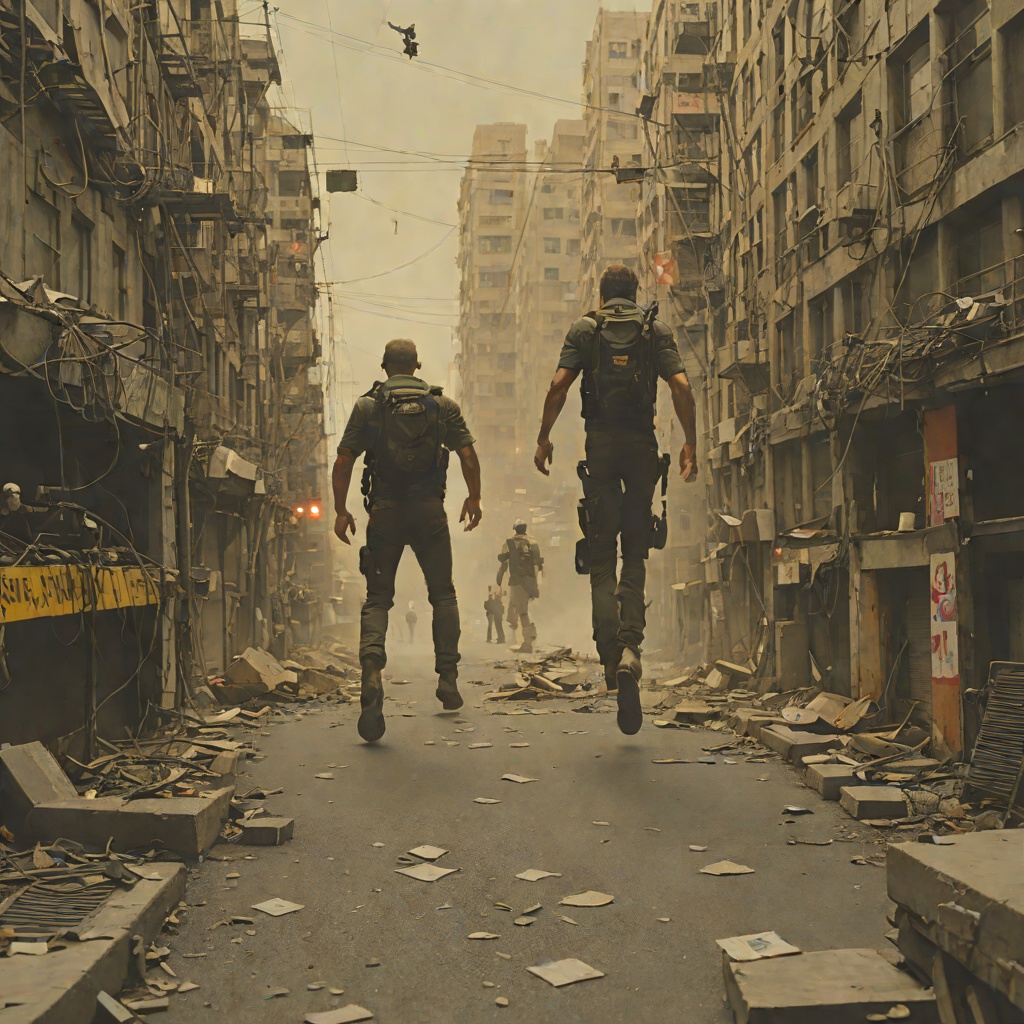
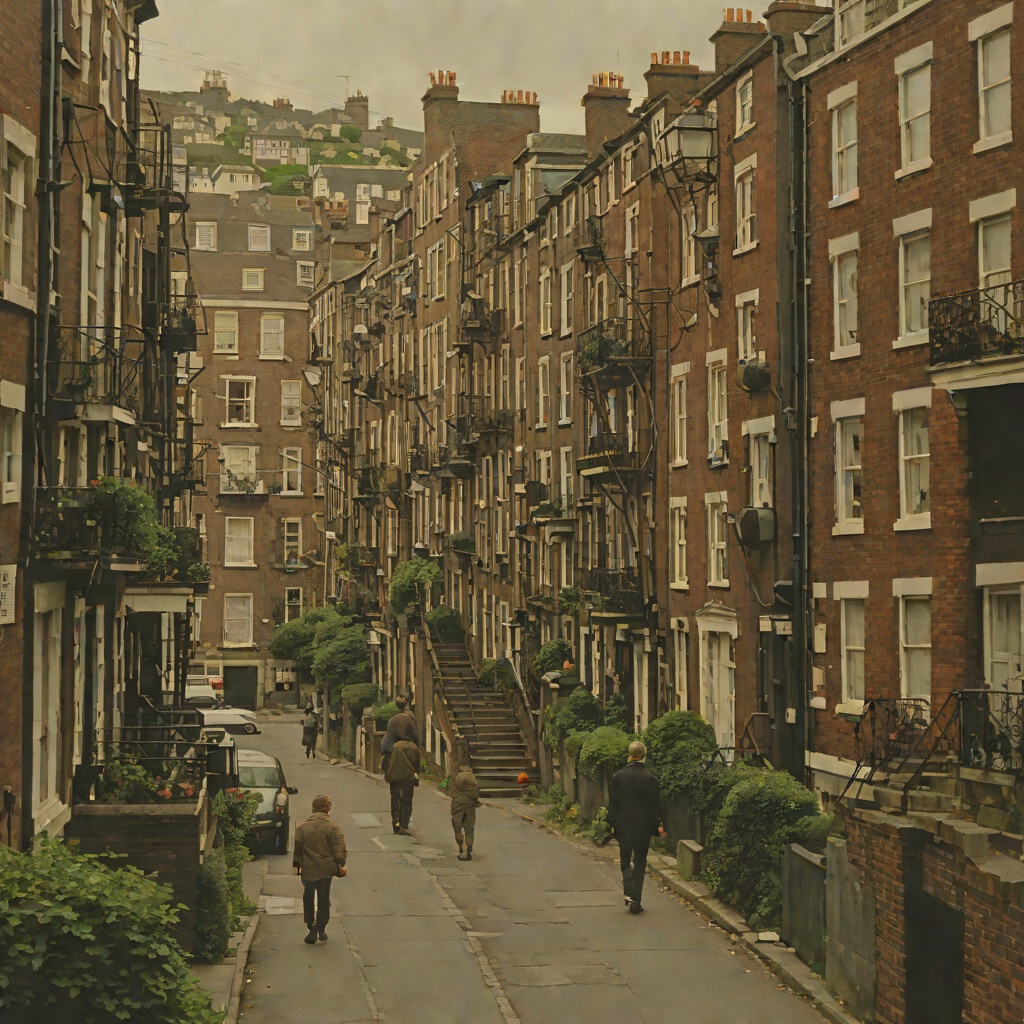
Co-Op City appears first as a vast Development whose high-rises rise through drizzle like the gray turrets of a penitentiary. From the apartment window, clotheslines flap over an airshaft while rats and plump alley cats move through the garbage below. The image joins mass housing to confinement: the buildings are enormous, but the residents possess little comfort, privacy, or mobility.
The Richards apartment has a Free-Vee because every Development apartment is required to have one, although residents may legally turn the set off. That limited freedom becomes revealing when Ben Richards begins watching big-money giveaways after his daughter Catherine Sarah Richards falls ill. The television is officially optional, yet its promises become almost unavoidable when a family lacks money for a doctor. In Co-Op City, entertainment is not merely distraction; it is an instrument that converts desperation into attention and possible submission.
The district’s weather and air make deprivation bodily. Rain and drizzle deepen the cold, while the apartment may be only about sixty degrees even when the public thermometer reads fifty-one. Catherine Sarah Richards has influenza, and the family cannot afford adequate medical care. The damp, sulfurous air outside and the cold interior create a continuous environment of illness rather than a single isolated crisis.
Poverty, Policing, and Infrastructure
When Ben Richards leaves the apartment, Co-Op City is described as a radiating rat warren of parking lots, deserted shops, Urban Centers, and paved playgrounds. The streets are ghostly and silent, with stripped vehicles left to decay and police rarely venturing south of the Canal. Cycle gangs effectively govern the area, so official news reports about courageous Block Police elsewhere appear as propaganda rather than a description of local reality.
Movement through the district is organized by poverty. Ben Richards walks because his weekly twenty-dollar unemployment allotment, paid in oldbucks, has already been spent; he cannot afford a pneumo-bus token. Four cycles roar past him, and someone throws a piece of asphalt, but the roving packs do not molest him, apparently sensing his poverty. The detail makes economic status a visible and dangerous identity, one that determines both exposure to violence and access to transportation.
The built environment records systematic abandonment. Crashed windows, wet garbage, graffiti, broken sodium lights, and deserted commercial spaces fill the route. The old lighting system remains unrepaired because it is funded in the new currency, while the unemployed residents of Co-Op City possess only oldbucks. The district is thus excluded not simply from wealth but from the maintenance systems that wealth purchases. Its darkness is an administrative consequence.
Free-Vee is the major infrastructure that still reaches everyone. Its cables are safely buried under the streets, and the population treats the medium as the stuff of dreams and the bread of life. Drugs cost oldbucks, but Free-Vee is available without direct payment, making it the one commodity the poor can consume continuously. Across the Canal, however, the dream machine runs on New Dollars, and only employed people possess them. The same medium therefore links the city while reproducing its class division.
The Canal and the Urban Class Boundary
Ben Richards crosses the Canal on his walk toward the Network Games Building. The crossing is both ordinary transit and a decisive spatial passage. South of the Canal lie four million people, almost all unemployed, surrounded by deteriorating infrastructure and social abandonment. North of it, the city becomes cleaner, wealthier, more closely policed, and visibly oriented toward the Games.
As Ben Richards approaches the Network Games Building, the contrast sharpens. The high-rises become clean and imposing, expensive movie houses and ungrilled smoke shops appear, and city police stand on every corner. Well-dressed mothers watch their children play on astroturf behind chain-link fencing, with police guarding the entrance to the People’s Fountain Park. The apparent order of the northern district depends on exclusion: the same policing that leaves Co-Op City exposed to cycle gangs becomes dense and immediate when an unemployed man crosses into privileged space.
Ben Richards’s clothing, haircut, and sunken eyes mark him as a southern resident. Uptown, the text suggests, such a man has only one socially assigned function: the Games. The qualifying-examination line extends for blocks beneath the shadow of the Games Building, and police watch those waiting with hands near gun butts and move-alongs. Co-Op City has produced the conditions of his desperation; the city beyond the Canal then interprets that desperation as a spectacle-ready identity.
Family Crisis and the Pressure to Leave
Co-Op City is inseparable from the Richards family’s medical and economic crisis. Catherine Sarah Richards’s influenza produces the immediate emergency, but the family has no money for modern equipment or a real doctor. Ben Richards rejects the block midwife’s dirty hands and whiskey breath because he believes his daughter needs professional treatment, while Sheila Richards resists the idea that he should enter the Games for a bounty.
Their argument exposes the district’s cruel conversion of family care into economic calculation. Ben Richards tells Sheila Richards that, at worst, she could receive oldbucks as the head of a fatherless house, while Sheila Richards refuses to accept what she regards as dirty blood money or a bounty on her husband. The choice is presented as voluntary only in form. In practice, Co-Op City has narrowed the family’s options until bodily danger becomes one of the few available sources of income.
The city also shapes Ben Richards’s self-understanding. He sees himself as a throwback, a man set apart from the present and potentially dangerous to the Network’s order. His decision to seek the qualifying examinations is not born from faith in the system. It is an attempt to force money into a household where unemployment, inadequate medicine, and cold housing have made ordinary responsibility impossible.
Recalled and Connected Spaces
Although Co-Op City is the opening urban environment, later locations echo and extend its logic. The Boston Y.M.C.A. is a huge, black, old-fashioned building that stands like the skeleton of a murdered idea, another neglected structure surrounded by signs of social decline. The abandoned Super Pine Tree Mall becomes an immense rat warren of unfinished stores, rusted steel, foundation holes, and overgrown lots. These spaces repeat Co-Op City’s combination of failed promises, decay, and confinement, but each also becomes a temporary node in Ben Richards’s movement through the society that produced him.
Co-Op City remains the point to which danger is expected to return. Dan Killian warns Ben Richards to stay close to his own people and says that the heat will be heaviest in Co-Op City when the truce breaks at noon the next day. The warning identifies the district as both a refuge and a target: it contains the population most vulnerable to repression, and it is the place authorities expect to control first.
The contrast reaches its most violent form at Voigt Airfield, where police, an A-62 tank, electrified fencing, passengers, employees, terminals, and a departing Lockheed/G-A Superbird turn infrastructure into a military enclosure. From Co-Op City’s broken sodium lights and unaffordable buses to the airport’s tank and controlled access roads, the novel presents space as politically produced. Some districts are left to decay; other spaces are overbuilt for surveillance, transport, and force. Co-Op City’s significance lies in making that division visible from the beginning.